
Julie Angerhofer, PhD, MPH

“It brings me a lot of joy to partner with health care providers and receivers to learn how to improve care delivery.”
Julie Angerhofer, PhD, MPH*
Associate Investigator, Kaiser Permanente Washington Health Research Institute
Scientist in Residence, Kaiser Permanente Center for Gun Violence Research and Education
Affiliate Assistant Professor, Department of Health Systems and Population Health, University of Washington School of Public Health
* formerly Richards
206-287-2100
Twitter: @jangerhofer
Biography
Julie Angerhofer, PhD, MPH, is passionate about improving care for mental health and substance use in partnership with people who provide and receive health care. She applies qualitative methods to inform what research questions we should be asking and how we should consider answering them. She employs statistical methods to inform implementation evaluations with a goal of optimizing care delivery and improving clinical practice effectiveness and patient outcomes.
Dr. Angerhofer has received grants from the National Institutes of Health, Centers for Disease Control and Prevention, American Foundation for Suicide Prevention, and Kaiser Permanente Center for Gun Violence Research and Education to research suicide prevention in health care systems via user-centered design and community-based participatory approaches. She also collaborates with multidisciplinary teams on a variety of mental health and addiction research projects, supports care delivery research partnerships, and mentors students at the University of Washington as an affiliate assistant professor.
Research interests and experience
-
Suicide Prevention
-
Alcohol and Drug Use
-
Behavior Change
Firearm injury prevention; alcohol and drug misuse; tobacco cessation
-
Mental Health
Depression; alcohol and drug use disorders; suicide prevention; self-management
-
Social Determinants of Health
Stigma
-
Health Services & Economics
Quality improvement, implementation cost
-
Preventive Medicine
Public and population health; screening effectiveness and uptake; evidence-based practice recommendations
-
Implementation Research
-
Addictions
Prevention and treatment
Sparc trial tools
Resources for behavioral health integration
The SPARC trial successfully implemented behavioral health care into primary care. On our website, you can access tools for behavioral health integration, as well as frequently asked questions and publications.
Recent publications
McClure JB, Swan GE, Catz SL, Jack L, Javitz H, McAfee T, Deprey M, Richards J, Zbikowski SM. Smoking outcome by psychiatric history after behavioral and varenicline treatment. J Subst Abuse Treat. 2010;38(4):394-402. Epub 2010 Apr 2. PubMed
Swan GE, McClure JB, Jack LM, Zbikowski SM, Javitz HS, Catz SL, Deprey M, Richards J, McAfee TA. Behavioral counseling and varenicline treatment for smoking cessation. Am J Prev Med. 2010;38(5):482-90. PubMed
McClure JB, Ludman EJ, Grothaus L, Pabiniak C, Richards J. Impact of spirometry feedback and brief motivational counseling on long-term smoking outcomes: a comparison of smokers with and without lung impairment. Patient Educ Couns. 2010 Aug;80(2):280-3. Epub 2010 Apr 29. PubMed
Richardson LP, Rockhill C, Russo JE, Grossman DC, Richards J, McCarty C, McCauley E, Katon W. Evaluation of the PHQ-2 as a brief screen for detecting major depression among adolescents. Pediatrics. 2010;125(5):e1097-103. Epub 2010 Apr 5. PubMed
Katon W, Richardson L, Russo J, McCarty CA, Rockhill C, McCauley E, Richards J, Grossman DC. Depressive symptoms in adolescence: the association with multiple health risk behaviors. Gen Hosp Psychiatry. 2010;32(3):233-9. Epub 2010 Mar 1. PubMed

Research

Suicide attempts decreased after adding suicide care to primary care
Safety planning and risk screening improved outcomes for adult patients.
Research

Understanding adoption of Lock to Live, a decision aid supporting suicide prevention
KPWHRI research finds ways to increase use of a firearm safety tool.
News
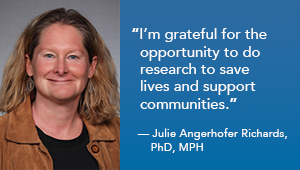
Kaiser Permanente expands gun violence prevention work
Equity-focused research by Julie Angerhofer Richards, PhD, MPH, is among the work supported by $3.2 million.
KPWHRI in the media
Suicide care in primary care reduces suicide attempts
Primary care intervention might reduce suicide attempts
MedPage Today, Sept. 30, 2024