
Susan Shortreed, PhD

“By using rich data sources such as electronic health records, we can begin to identify which treatments will work best for which people.”
Susan M. Shortreed, PhD
Senior Biostatistics Investigator, Kaiser Permanente Washington Health Research Institute
Affiliate Professor, Department of Biostatistics, University of Washington
Susan.M.Shortreed@kp.org
206-287-2088
Biography
Susan Shortreed, PhD, uses statistics and machine learning methods to address health science problems, with a special emphasis on analyzing complex longitudinal data. She develops and evaluates statistical approaches for observational data and works to improve the design and analyses of studies that use data collected from electronic health care records. She led a project to develop statistical methods for constructing personalized treatment strategies using data captured from electronic health records.
Dr. Shortreed earned her PhD in statistics from the University of Washington. Then she spent two years in the Department of Epidemiology and Preventive Medicine at Monash University in Melbourne, Australia, and two years in the School of Computer Science at McGill University in Montreal, Canada. Dr. Shortreed has collaborated with scientists in a broad range of areas including alcohol use, cancer screening, and medication safety. She now works alongside researchers in mental and behavioral health, evaluating and comparing treatments for chronic pain and depression, and interventions to prevent suicide. Dr. Shortreed is the Analytic Methods Core Lead the Mental Health Research Network, helping to design studies to address important public health concerns, such as determining which antidepressant medications work best for which patients and developing risk prediction algorithms to identify individuals who may be at increased risk for suicide.
Dr. Shortreed is also an affiliate professor of biostatistics at the University of Washington School of Public Health. She served on the executive board for the American Statistical Association’s Mental Health Statistics Section and the editorial boards for Observational Studies and Biometrics.
Research interests and experience
-
Biostatistics
Design and analysis of studies that use data collected from electronic health records; analysis of complex longitudinal data; methods for constructing personalized treatment strategies, computational statistics and algorithms; machine learning; variable selection methods.
Medication Use & Patient Safety
Biostatistics; machine learning; using data collected from electronic health records to study rare adverse events; opioid safety; medication safety in pregnancy.
-
Mental Health
Biostatistics; treatment for chronic depression; suicide prevention; developing personalized treatment strategies; developing risk prediction models.
Recent publications
Harrington LB, Powers JD, Bayliss EA, Fortmann SP, Shortreed SM, Walker RL, Floyd JS, Kuntz J, Fuller S, Alberston-Junkans L, Lee MH, Temposky LA, Dublin S Current use of estrogen-containing oral contraceptives or hormone therapy and risk of COVID-19 infection and hospitalization: a population-based cohort study 2024 Oct 7;193(10):1417-1425. doi: 10.1093/aje/kwae066. Epub 2024-05-16. PubMed
Wolock CJ, Williamson BD, Shortreed SM, Simon GE, Coleman KJ, Yeargans R, Ahmedani BK, Daida Y, Lynch FL, Rossom RC, Ziebell RA, Cruz M, Wellman RD, Coley RY Importance of variables from different time frames for predicting self-harm using health system data 2024 Sep 20 doi: 10.1101/2024.04.29.24306260. Epub 2024-09-20. PubMed
Moodie EEM, Bian Z, Coulombe J, Lian Y, Yang AY, Shortreed SM Variable selection in high dimensions for discrete-outcome individualized treatment rules: Reducing severity of depression symptoms 2024 Jul;25(3):633-647. doi: 10.1093/biostatistics/kxad022. Epub 2023-08-31. PubMed
Simon GE, Cruz M, Boggs JM, Beck A, Shortreed SM, Coley RY Predicting Outcomes of Antidepressant Treatment in Community Practice Settings 2024 May;75(5):419-426. doi: 10.1176/appi.ps.20230380. Epub 2023-12-05. PubMed
Simon GE, Rossom RC, Iturralde E, Ahmedani BK, Waring SC, Owen-Smith AA, Sterling SA, Miley K, Stults CD, Daida YG, Lynch FL, Beck A, Sanchez K, Coleman KJ, Shortreed SM Clozapine Use Among People With Psychotic Disorders Who Experience Specific Indications for Clozapine 2024 Apr 29;85(2). doi: 10.4088/JCP.23m14833. Epub 2024-04-29. PubMed
Ralston JD, Anderson M, Ng J, Bashir A, Ehrlich K, Burns-Hunt D, Cotton M, Hansell L, Hsu C, Hunt H, Karter AJ, Levy SM, Ludman E, Madziwa L, Omura EM, Rogers K, Sevey B, Shaw JAM, Shortreed SM, Singh U, Speight J, Sweeny A, Tschernisch K, Sergei Tschernisch S, Yarborough L Preventing severe hypoglycemia in adults with type 2 diabetes (PHT2): Design, delivery and evaluation framework for a randomized controlled trial 2024 Apr;139:107456. doi: 10.1016/j.cct.2024.107456. Epub 2024-01-20. PubMed
Bian Z, Moodie EEM, Shortreed SM, Lambert SD, Bhatnagar S Variable selection for individualised treatment rules with discrete outcomes 2024 Mar;73(2):298-313. doi: 10.1093/jrsssc/qlad096. Epub 2023-11-02. PubMed
Simon GE, Johnson E, Shortreed SM, Ziebell RA, Rossom RC, Ahmedani BK, Coleman KJ, Beck A, Lynch FL, Daida YG Predicting suicide death after emergency department visits with mental health or self-harm diagnoses 2024 Mar;87:13-19. doi: 10.1016/j.genhosppsych.2024.01.009. Epub 2024-01-22. PubMed
Simon GE, Cruz M, Shortreed SM, Sterling SA, Coleman KJ, Ahmedani BK, Yaseen ZS, Mosholder AD Stability of Suicide Risk Prediction Models During Changes in Health Care Delivery 2024 Feb;75(2):139-147. doi: 10.1176/appi.ps.20230172. Epub 2023-08-17. PubMed
Spicker D, Moodie EEM, Shortreed SM Differentially Private Outcome-Weighted Learning for Optimal Dynamic Treatment Regime Estimation 2024 Jan 17;13(1). doi: 10.1002/sta4.641. Epub 2024-01-17. PubMed

Research

COVID risks not meaningfully greater with estrogen-containing medications
Oral contraceptives, hormone therapy not linked to more severe COVID outcomes.
Research

A medication that can relieve symptoms of psychosis is underused
Study finds that many patients who might benefit from clozapine don’t receive it.
Research

New findings on treating hypertension in pregnancy
A study led by Dr. Sascha Dublin finds similar outcomes for 3 hypertension medications, filling an evidence gap.
COVID-19

Greater infection risks linked to COVID-19 disparities
New work by Susan Shortreed, PhD, finds infection risks drive worse outcomes for some racial and ethnic groups.
Drugs, diabetes, disparities
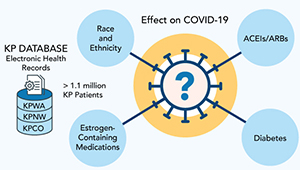
Studying COVID-19 risk and outcomes
Dr. Sascha Dublin tells how studies of KP electronic health record data can improve COVID-19 treatment and prevention.
KPWHRI IN THE MEDIA
Simpler models for predicting suicide risk work comparably to more complex ones
Q&A: Simple machine learning model predicts suicide risk well
Healio Psychiatry, April 12, 2023