Doctor and patient reminders improve lung cancer screening
Timely "Stepped Reminders" can help more people return for annual screening, study finds
For people at higher risk of lung cancer, staying on track with screening can be lifesaving. Yet many do not get annual lung scans. A new Kaiser Permanente Washington study found that well-timed reminders to doctors and patients helped more people return for yearly screening.
What do we know already?
Annual lung cancer screening with low-dose computed tomography (LDCT) scans is recommended for adults who have a higher risk of lung cancer because of their age and tobacco history. Screening saves lives by finding cancer early, when it is easier to treat, but only 22% to 50% of people eligible for lung cancer screening in the U.S. get annual scans. This is well below the screening rates for breast cancer (76% to 81%) and colorectal cancer (59% to 65%), even though lung cancer causes more deaths each year than these cancers combined.
Many factors can keep people from returning for annual lung cancer screening, but research points to 2 factors that may be especially important: knowing when to return for screening and receiving sufficient reminders to schedule a screening scan. In the new study, researchers created and tested 2 interventions to address these factors:
- A health communication intervention, which used print materials and video to share key messages about lung cancer screening, including the need to repeat screening annually. These materials were provided to patients 3 weeks after their last scan.
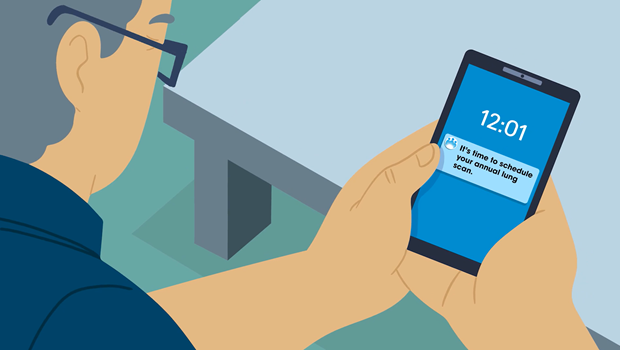
- An intervention called “Stepped Reminders,” which prompted primary care doctors to place orders for LDCT scans 4 weeks before patients were due for screening. Patients then received outreach through health portal messages and mailed letters reminding them to schedule their scan, as well as a follow-up call if needed.
“We worked really closely with Kaiser Permanente Washington patients, clinicians, and leadership to develop our interventions and seamlessly integrate them into routine care during the study to make it easy to do the right thing,” said lead researcher Karen Wernli, PhD, a senior investigator at Kaiser Permanente Washington Health Research Institute (KPWHRI).
What did the new study find?
The study, published in JAMA Internal Medicine, included 1,837 Kaiser Permanente Washington members ages 50 to 78 who completed lung cancer screening with normal results between November 2022 and April 2024. They were randomly divided into 4 groups that received one of the following: the health communication intervention, the Stepped Reminders intervention, both interventions, or usual care (no additional intervention).
The researchers then looked at how many people returned for lung cancer screening within 9 to 15 months of their last scan.
The results for the Stepped Reminders intervention were striking: 76% of people who received this intervention completed annual screening compared with 48% of people who did not receive the intervention, a difference of 28%. When the researchers looked separately at people who were currently using tobacco, the effect was even greater: 73% of those who received this intervention completed annual screening compared with 41% of people who did not, a difference of 32%. “These findings were particularly notable because people with a significant tobacco history often experience stigma and stop engaging in health care,” Wernli said. “Our results demonstrate that standard, consistent messaging overcomes some of those gaps.”
Overall, the return screening rate for those who received the Stepped Reminders intervention was comparable to the national rate for breast cancer screening, a type of screening that also involves an imaging scan.
In contrast, the health communication intervention did not improve screening rates. However, a separate analysis did find that the intervention increased the number of people who knew to return annually for screening — and was particularly impactful among first-time screeners. The authors noted that offering the communication intervention at another time, perhaps closer to when patients are due for a lung scan, could potentially boost its impact on repeat screening.
The study’s findings help fill an important gap by identifying effective ways to improve annual lung cancer screening, an area of preventive care where evidence-based guidance remains limited. The Centers for Disease Control Community Guide currently offers recommendations for increasing breast, cervical, and colorectal cancer screening, but not lung cancer screening.
“We demonstrated that well-timed outreach to doctors and patients can make a real difference in helping more people stay on track with annual screening,” Wernli said. “That matters because screening works best when it happens year after year. By supporting patients in returning for annual scans, health care organizations can help more people benefit from early detection and treatment.”
Wernli’s KPWHRI coauthors on the study include Melissa Anderson, Nadejda Bezman, Hongyuan Gao, Beverly Green, Casey Luce, Lorella Palazzo, James Ralston, Kristine Rogers, and Yu-Ru Su.
Read the paper: Health Communication and Stepped Reminders Interventions for Lung Cancer Screening: A Randomized Clinical Trial
By Sophie Ramsey

Research
Helping first-time screeners know when to return
Well-timed outreach in print and video can boost awareness of repeat screening for lung cancer, study finds.
Co-designing with patients

Patient collaboration sparks care innovations
By partnering with patients, KPWHRI researchers developed 2 new interventions to boost lung cancer screening.
Research

Improving cancer prevention and early detection
How KPWHRI is contributing to better cancer screening and better outcomes for patients.
Live healthy
What is shared decision-making?
An explanation from KPWHRI researchers about discussing treatment options with a medical provider.